
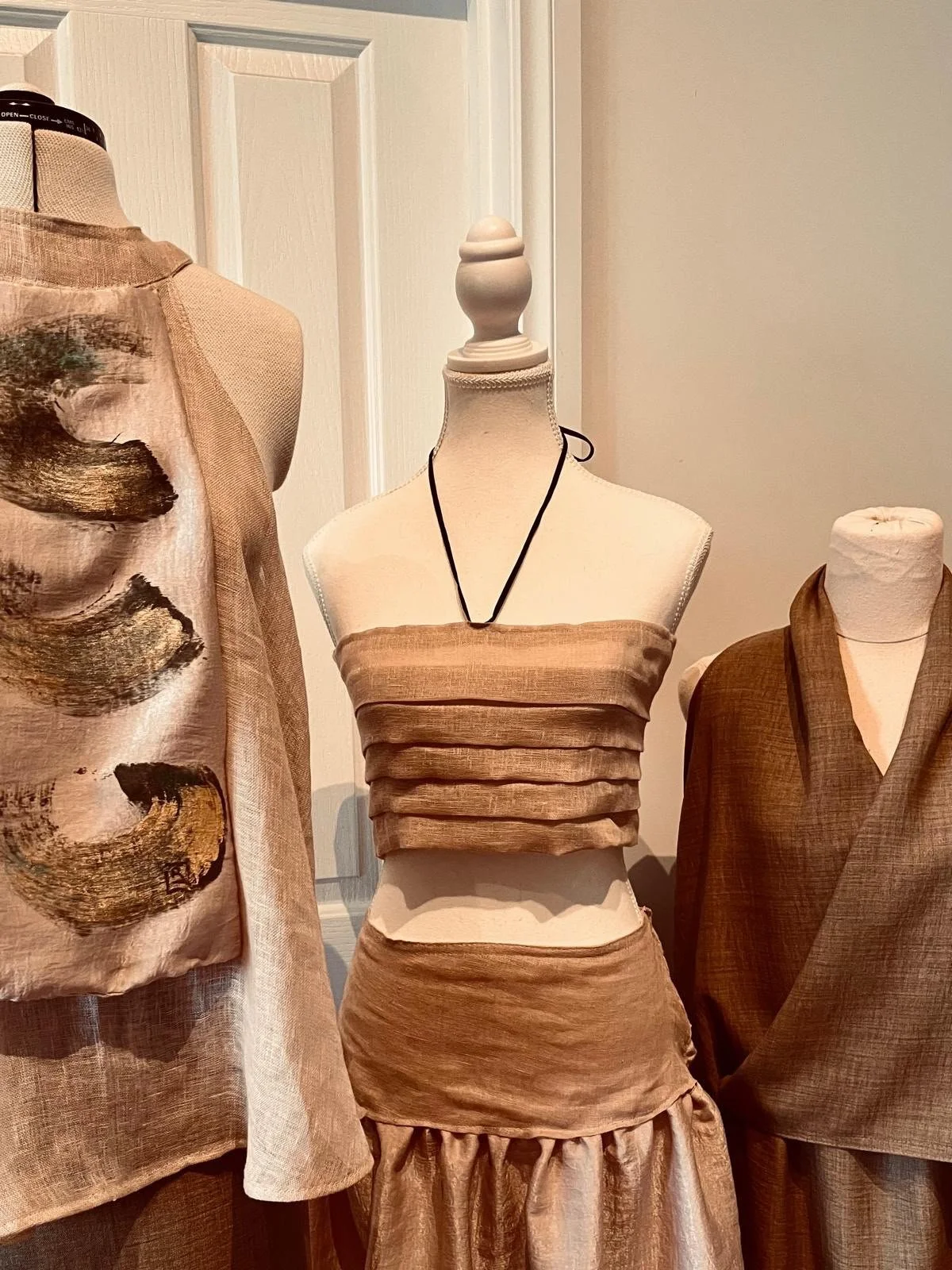
How does your collection interpret “Handmade for the Earth” through your choice of techniques and materials?
For me, “Handmade for the Earth” is about slowing down and being more conscious of what we create, how we create it and what happens to it afterwards.
My collection reflects this philosophy with thoughtful, sustainable materials and hands-on techniques. I enjoy working directly with the fabric, experimenting with painting, surface design, cutting and sewing to transform materials into something unique.
Rather than following a mass-production approach, each piece is individually considered and made. This allows me to minimise waste, reuse materials where possible and give fabrics a new life.
The handmade process is also important because it creates a connection between the designer, the garment and the person who eventually wears it. Every piece carries evidence of the human hand, making it individual rather than disposable.
What specific artisanal process defines this collection?
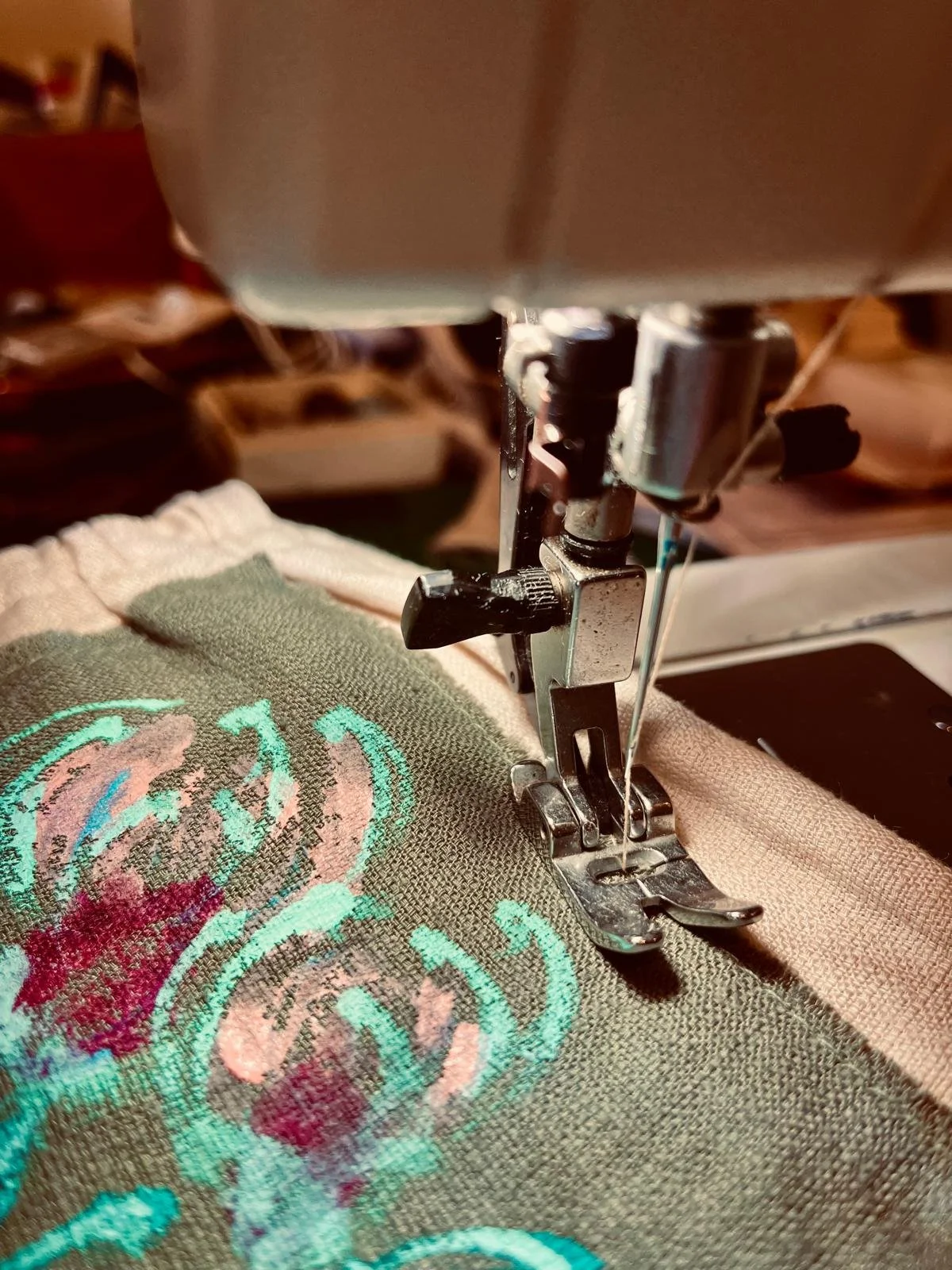
Some of the defining elements of my collection is the combination of sewing and hand-painted surface design.
Painting has been part of my creative life from an early age, through my father's passion for painting and my own studies in Graphic Design. Sewing came from watching my mother create garments when I was young.
Bringing these two influences together allows me to treat the fabric almost like a canvas. I can paint, manipulate and construct the textile before turning it into a finished garment.
I love that this process is unpredictable. Each painted surface is slightly different, so no two pieces are ever the same. It gives the collection a very personal, handmade quality while allowing me to explore environmental ideas through the designs.
How does your work incorporate or preserve cultural craftsmanship without losing a contemporary edge?
I believe traditional craftsmanship has an important place in contemporary fashion because many of the techniques developed over generations are based on making, repairing and valuing garments rather than treating them as disposable.
My approach is influenced by these principles of craftsmanship, particularly the patience and skill involved in creating something by hand.
At the same time, I want LJR Designs to have a distinctly contemporary identity. I combine traditional sewing skills with modern silhouettes, graphic influences, hand-painted textiles and environmental concepts.
For me, it is not about reproducing the past. It is about taking the values of craftsmanship—care, skill, individuality and longevity—and interpreting them in a way that feels relevant to today's world.
If your collection involves traditional techniques, how did working with these techniques shape your process as a designer?
Working by hand has taught me to slow down and allow the design to develop rather than trying to control every stage from the beginning.
When I sew, paint and manipulate fabric myself, I can respond to the material as I work. Sometimes a particular texture, mark or piece of fabric will suggest the direction of the next part of the design.
This makes the process much more intuitive and personal.
My mother introduced me to sewing by allowing me to watch and learn from her, while my father inspired my appreciation of painting. These early influences have stayed with me and have become an important part of how I design today.
I think this is one of the reasons handmade fashions is so meaningful to me—it connects my creative journey from childhood with the designer I am today.
What was the most challenging sustainable constraint you navigated while building this runway collection?
One of the biggest challenges is trying to create something visually strong and exciting for the runway while remaining conscious of waste and environmental impact.
There is always a temptation in fashion to keep adding more—more fabric, more embellishment, more new materials. I have tried to approach the collection differently by asking myself whether something is necessary and how I can make the most of the materials I already have.
Working sustainably can take more time because you cannot always simply order exactly what you want. You must be resourceful, experiment and sometimes redesign around the materials available to you.
But I see that limitation as part of the creative process. It forces me to think differently and can lead to more interesting and unexpected designs.
How do you ensure your garments remain truly low-impact across their entire life cycle, from source fibre to end-of-use?
I try to consider the life of a garment beyond simply creating the finished piece.
For me, sustainability begins with being thoughtful about the materials I select and avoiding unnecessary consumption. I also focus on making garments that are distinctive and well-constructed, so they are designed to be valued and worn for longer.
I believe longevity is one of the most important aspects of sustainable fashion. If someone loves a garment and continues to wear it for many years, that garment has a very different environmental impact from something designed to be worn a few times and discarded.
I also believe garments should hav the potential for repair, alteration, reuse or transformation rather than automatically becoming waste.
Ultimately, I would like LJR Designs to encourage people to see clothing as something to care for, keep and connect with and not something disposable.
What message or feeling do you hope the Western Australian audience takes away from viewing your pieces on the runway?
I hope the audience feels curious, inspired and perhaps a little challenged by what they see.
I would like the collection to demonstrate that sustainable fashion does not have to mean compromising creativity, individuality or beauty.
My work explores the relationship between fashion, people and our changing planet. The Anthropocene has influenced the way I think about this relationship and has encouraged me to question the impact that our choices have on the world around us.
I would love the audience to look closely at the garments and recognise the human work behind them—the painting, sewing, experimentation and thought that has gone into each piece.
Most importantly, I hope they leave thinking differently about their own clothing, be inspired and recognising the value of handmade, considered fashion.
What do you believe events like EFWA can do to shift the mindset toward valuing slow, handmade textiles?
I think events like EFWA are incredibly important because they allow people to experience sustainable fashion rather than simply hearing about it.
When an audience sees a handmade garment on the runway, they can begin to appreciate the time, skill, creativity and thought behind it. It becomes much harder to view that garment as simply another piece of clothing.
Fashion has become so fast that we can sometimes forget the human hands behind what we wear.
EFWA creates an opportunity to slow that conversation down and celebrate designers, makers and artisans who are creating with intention.
I believe the future of fashion needs to be more thoughtful. It is not necessarily about stopping fashion—it is about changing our relationship with it. We can still celebrate creativity and self-expression while making choices that are kinder to our planet.
For me, “Handmade for the Earth” is ultimately about reconnecting people with the value of making, wearing, keeping and caring for what we own.