

EFWA Runway photography by Harry Leonard Imagery
What drew you to become a fashion designer?
Honestly, I have kind of fallen into it! If you has asked me 3 years ago whether I would be having this conversation in 3 years’ time, I would have laughed. I have always loved jewellery and made my own, I’ve sewed and played around forever, particularly when my daughter was little. I’ve always watched my Grandmother and Mother mend, patch, hem and turn one thing into something else if it was needed – I thought that was what everyone did!
My passion is paper, and handmade paper. I closed the door on my mother one day, and told her we needed to talk… I thought we would be able to make beads from our paper and use the beads to make jewellery. So I went and found the box of my jewellery making stuff that had been hidden away under a bed and started to create prototypes. I wanted to create something remarkable and memorable that people could take away with them that would remind them of this amazing part of the country.

Over the last 2 years my designs have become the foundation of The Conner Collection and The Dawn Collection - permanent artisan jewellery collections made exclusively from Curtin Springs Paper. The Red Heart Collection was launched at Eco Fashion Week Australia in 2017 as an ‘art’ collection and an extension of this work, showcasing handmade paper, sustainable jewellery and Central Australia on an international platform.
I’m continuing to grow and develop and learn and am working toward the next stage of my career and my art, and slowly becoming more comfortable with describing words like ‘artist’ and ‘designer’.
How do you incorporate ideals such a Zero Waste into your work?
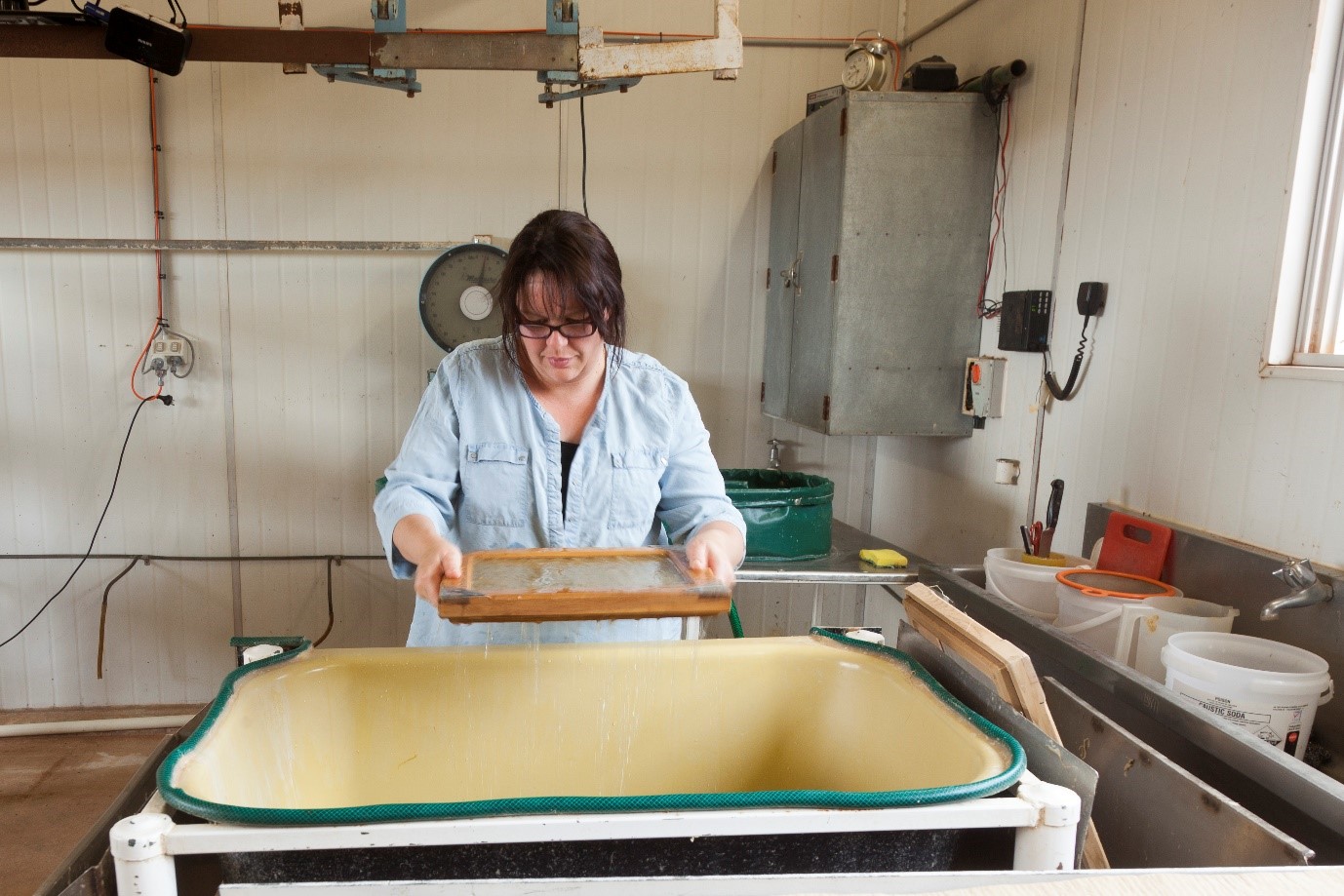
- How we make the paper.
- Hand cut the grass, making sure the integrity of the plant is not impacted.
- The water is all bore water from underground. All the waste water is retained onsite, filtered through our sand dunes before returning to the rock strata that holds the water.
- We us recycled solar panels to power the Old Abattoir.
- We have used and reused old items of equipment to make the equipment we need to make paper. We have only purchased 1 item – a Hollander Beater which is a specialized paper-making piece of equipment.
- We use recycled shower curtains and sheets from the accommodation part of our business to use in the pressing of the paper.
- We collect flowers to include in the paper and jewellery.
- We use cow poo (cooked) to include in the paper - the ultimate recycling!
- We use the cut tail hair from cattle to include in the paper.

Part of the concept behind making jewellery from Curtin Springs Paper was a way to use the pieces of paper that had more flaws than character that we couldn’t sell as a premium product. Those ‘scrap’ pieces are squirreled away then cut and used to make beads, or other shapes ready to start their new life adorning a body as a piece of jewellery. We sometimes get to a point where I get really picky about what a perfect sheet of paper is so I can use it in jewellery making. I recreate or alter designs to use materials I have on hand, either for jewellery or clothing.
Where do your find inspiration for new work?
My home is a constant source of inspiration. Our landscape constantly changes, the plants and wildlife. We have mothered and cared for and released birds, micro bats, kangaroos, emus and calves. We have a 360 degree horizon, more stars than anyone else normally sees and we can watch the full moon rise as the sun sets every month. We have salt lakes that change as you watch, and the magnificent Mount Conner which moves through all shades of orange to deep purple through the day. If I ever feel stuck, I just go for a walk or a drive out onto the property. There is always something that will catch my eye and germinate the next idea. Most of the time I feel like I have more ideas than I will ever have time to produce them.
I have an old abattoir building that has been converted into our paper mill as my large work space, a small studio in my home, an old shipping container converted into a gallery and workshop space, and of course a million acres as a backyard.

What materials do you work with – organic, reclaimed, etc.?
The primary material I work with is Curtin Springs Paper – the paper we make here by hand that is made from the native grasses and plants that grow on the station. Each of the grasses give the paper a different quality, texture and colour. There will never be two pieces of paper the same.
Paper and paper pulp is such an amazing thing – you can tear, sew, stick, sand, drill, rust, twist and the list goes on. I love to see how far I can push it. Paper is more versatile and hardy then people think.
I then add anything else I can get my hands on. This is usually upcycled or reclaimed materials. We live almost 400km from the nearest store - so I find ‘forgotten’ things in old cupboards, rusty things from ‘down the back’, material from the sewing box etc. I also like to see how our handmade paper can be incorporated into and combined with other materials like wool in the felting process or with metal and rust.
I have an entire Merino fleece from a farming friend sitting on my table at the moment that I’m not sure where to start with, but am sure it will turn into many amazing things!

What are the biggest challenges you face as an sustainable designer?
People’s idea of what ‘sustainable’ or ‘eco’ is. Also the challenge of finding the right and correct and best way to market my products. How do we make sure our commitment to marketing is affordable and achieving the right outcomes. Who will really appreciate our story? How do we get people to really understand and love the product like we do?
How do you help customers understand the higher cost of sustainable garments when they are so inundated with sweat shop-produced cheap merchandise?
We run multiple tours a day over to the Old Abattoir to talk to people about the Central Australian landscape, the grasses, our relationship with the land and the process of making paper by hand in the desert. People really love learning about the process, and seeing how we have reused and recycled different things to make everything we need to make paper. We find that most people really start to understand how involved making the paper is, and as a follow on learn about the products we make including the jewellery collections. We find that when people know the story and have been involved in the process they are more able to reconcile the cost of the process and are then comfortable to part with their money for a one off item that is hand made from the land which they have spent time in.
I think being able to tell our stories well is the first step of helping the consumer understand and appreciate the value of sustainable garments.
What can we look forward to seeing on the runway at Eco Fashion Week Australia 2018?
Classic and simple lines with imagery from the Red Centre landscape and a completely different way of looking at grass and handmade paper.

How do you incorporate sustainable living in other areas of your life?
I live in a place where we have to be completely self-sufficient. We have to pump and monitor our own water, generate our own electricity and manage our own waste. We are very conscious about how we use our resources. We use solar power in the Old Abattoir, and have researched other alternative power sources for new buildings. The water we use is eventually filtered naturally back through the layers of sand and rock into the reserves where we then pump it back up again. The chickens eat the food scraps and give us eggs in return and we get the most amazing tomato crop from the septic dump happens every few years.
Sustainability is the core of our business and our life, it’s not something we have to think about it’s just something we do.
Anything else you would like readers to know?
There is something really exciting and humbling about working with a material that is, in every sense of the word, home.
Social Media Links -
- Website - www.curtinsprings.com/curtin-springs-paper
- Facebook - www.facebook.com/Curtin-Springs-646583098773509
- Instagram - @am_paperarts
- Youtube - www.youtube.com/channel/UCDSbzhoO0994zrocDb8cD_g


