Your journey to fashion design was unique to say the least as you were a textile artist first. Can you share a bit about how your move to fashion came about?
Where did my fashion journey begin – in Daegu!
I was sent to Korea by the government of Western Australia (WA) to represent WA in Korea as a textile artist and designer of Atelier Zuhal . I met with fashion designers for the first time during the event week. My textile art was the centre of attention but also a disappointment for many fast fashion designers who realized that it wasn’t available in large enough quantities to work to them. My exhibition space was full of Korean textile students listening my presentations.

The handmade gown I was wearing was also a centre of attention. I had created it just to show off my textile art. On the way back home during the flight, I was thinking about the suggestion by a German fashion designer who liked my gown and textiles, “You are an artist, Why not have a go yourself?’’ Why not? After all fashion is 3D textile sculpture as far as I was concerned, so I decided to focus on creating wearable forms of my textiles while still staying Eco.
Soon after the Korea trip I was invited to a fashion show to show my work. In one week – all by myself in my studio – I created eight garments for this first series from the textiles I had just shown in Korea. Luckily I had the technical skill. My first collection is named- ‘’ Night in the Bush’’ (you can see it in my portfolio at Green Embassy - Night in the Bush)

Why was it important to you to offer a sustainable, responsible, eco fashion line?
I love all animals, so I wanted to become a Veterinary Surgeon. Then because of my passion for the environment and conservation of the planet and all its flora and fauna, I taught animal conservation and ecology for many years. in England.
As a creative person, my move to visual arts didn’t change anything. My passion for protecting the environment and wildlife became my artistic concept. Now it has become my mission as a fashion designer. I can talk visually and deliver my concept to millions via runways. It wasn’t enough for me to work in veterinary clinics, higher education classrooms or Art Galleries. Green Embassy is my visual language and each piece is my lesson to educate others in conservation and sustainability. I just hope many good students are out there to hear and embrace this lesson.

How do you incorporate ideals such a Zero Waste into your work?
All my fabric cut are utilized. Each of my collections consist of accessories created from fabric scraps and I always create new ones such as with Silent Rainforest. Tiny fabric pieces became bow ties inspired by the butterflies of the forest. With the Earth series, fabric scraps become elaborate head pieces. In the Connected to Land series, they became textile jewellery. In my latest collection, all left overs are going to be fashioned into headpieces
What can we look forward to seeing on the runway in November 2018?
My new collection is inspired by THE IUCN RED List of threatened species ( also known as IUCN Red List or Red Data List). Founded in 1964, this list has evolved to become the world’s most comprehensive inventory of the global conservation status of biological species. I have focused on our very own endangered species - the ones belonging to Perth - the Carnaby’s Black-Cockatoo. This beautiful bird has white tail panels, white cheek patches and lives only in Southwest Australia where large scale land clearing for farming has fragmented much of its habitat, particularly mature eucalypts such as salmon gum and wandoo that have suitable hollows for nesting .

My new collection will be black and white only , light, majestic and delicate with textures created by the application of embroidery, nuno felting, knitting and crochet on fabrics including silk organza, organic cotton, alpaca, and merino wool as well as op shop fabrics, and old curtains.
How do you help customers understand the higher cost of sustainable garments when they are so inundated with sweat shop-produced cheap merchandise?
There is no such thing as sustainable garments costing higher...it's true. The real cost when producing in an ethically and environmentally friendly manner is reflected in the price. My customers understand this and look after their Green Embassy piece so it will last for generations, as these garments are not cheap or disposable. They are proudly created in Australia - a single fibre, to a textile by an artist and then to finished pieces by skilled Australian couturiers

Jewellery created from fabric scraps for her Connected to the Land Series
Over the last 4 decades, creation of low-cost disposable clothing in an unethical, unsustainable way while abusing human rights, our oceans and our environment only helps to condition people that garments are worth nothing because they are so cheap.
Do you incorporate sustainable living in other areas of your life?
We are living as a family, and my Green Embassy studio is located, on a hobby farm on the outskirts of metropolitan Perth City. This six acres of organic land provides us with plenty wood for winter and alpacas droppings for compost to improve the quality of our soil. We are careful of water consumption in our dry city, keep pet chickens (totally free range and all of them have names) , grow our own fruits, herbs and recycle my studio water in our garden flower bed. Our majestic eucalyptus trees are home to many bird species

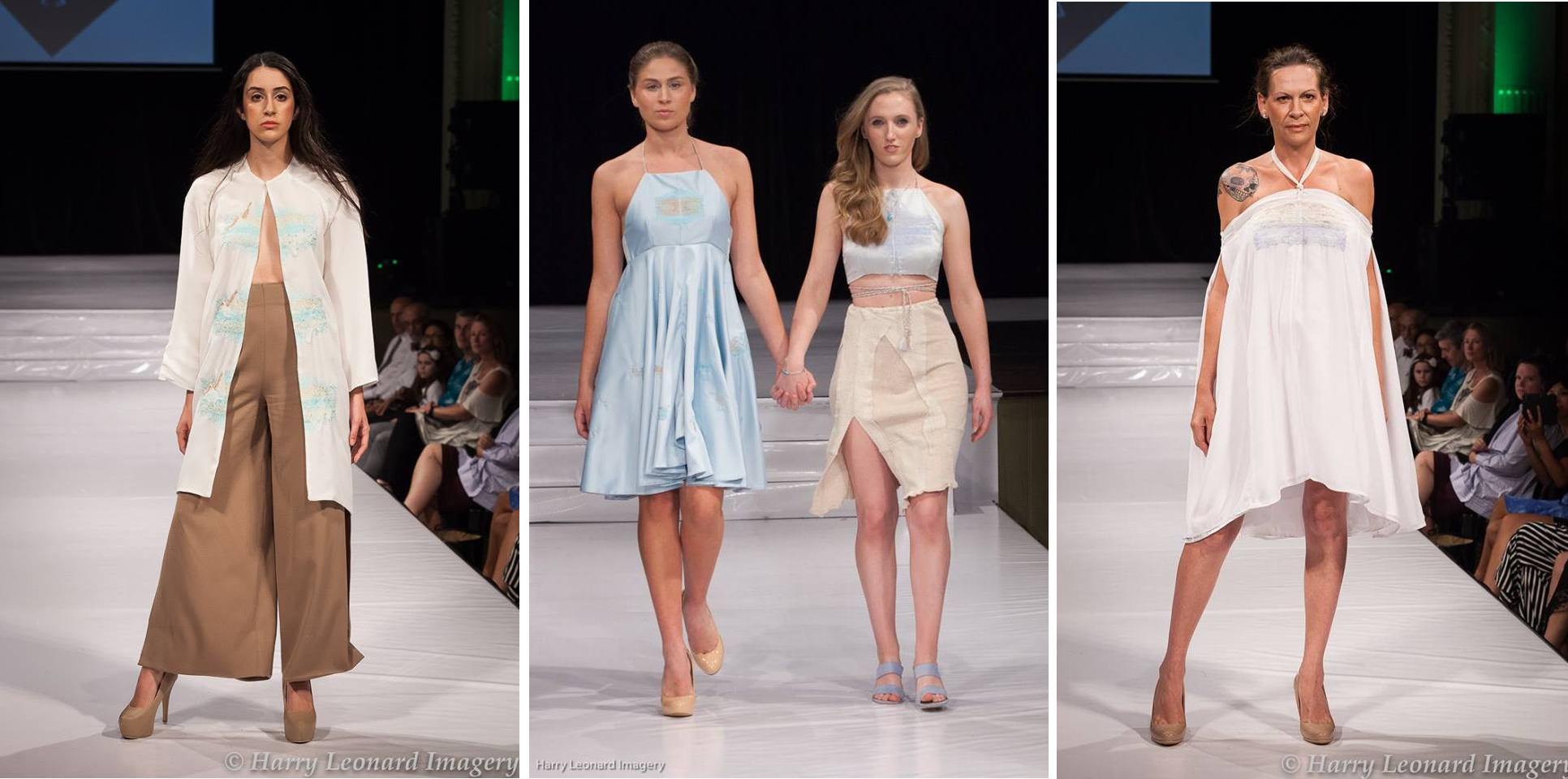
Green Embassy Collection shown at Eco Fashion Week Australia 2017 in Perth
Please share how the you came to found and organize the first ever Eco Fashion Week Australia in 2017?
It was four years ago that my application to show at Perth Fashion Week was rejected. I was told they were not interested in showing the work of Eco designers. I was also told the Eco fashion business is not sustainable, I had already shown in many other countries, so decided it was about time Australia should have a national Eco fashion Week of our own that would involve our large community, designers, artists, schools and local governments. It would not be based on trade show principles or only appeal to hand full of fashionistas. I quickly realized many people had a similar passion. Strangely enough, far too many people were already just awaiting for the magic to happen at our quiet mining city. It was like starting a small spark that quickly turned into a bush fire.
I am so excited to be in the middle of organizing our second year and it's going to be amazing. For 2018, Eco Fashion Week Australia will now be held in two states - Western Australia and Queensland. Our Port Douglas event will run from Nov. 4-10th and our Perth event will run from Nov. 15-21st.

You have created the Anita Moon awards to honour Australian Emerging Designers, Student Designers, Home Sewers . Please share a little bit about who Anita Moon was and the inspiration behind these awards.
Anita Moon was an Australian artist originally from Queensland and a neighbor of mine for eight years. She was my closest friend. We had so much in common, especially our love for nature, wildlife animals and art. She often used to pop in for morning coffee and listen to me patiently for many hours as I shared my crazy ideas, looked at my work and supported me when I was down. On one of those mornings when I was complaining about that we didn’t have our own Eco fashion show and I had to fly other side of the world to show my work, she suggested an Eco fashion week in Perth. Moon was also very keen on good education for care of the environment and wildlife, so we both agreed that education should be a focus at Eco Fashion Week Australia, not just the amazing fashion designs.

Eco fashion and art will provide inspiration to the public and younger students in Australia for years to come. Going forward it will encourage young designers to embrace an Eco path. Before she passed, Moon had a chance to learn about the establishment of Eco Fashion Week Australia. She left too suddenly. Sometimes I feel all this work is too hard, but then I remember she believed in me and always told me you must do it. I also am grateful for the many designers supporting this dream and the many friends and numerous community members as volunteers who are working to help her dream come true. I am grateful to everyone and feel I owe it to her to complete this mission. The Anita Moon Awards were created to inspire our youth and anyone else to go one more step ahead , refuse to settle for less .She was always an encouragement to me.
This year we have sponsors for the Anita Moon Awards, providing Australian Student and Emerging Designers two weeks of residential work experience and a designer in residency at farm studios, with flights and full board covered. The sponsors are: Curtin Springs Paper - Best Student Award and Green Embassy - Best Emerging Designer Award.

Education is an important part of EFWA. What do you hope attendees take away from this event?
They will see how fashion can be beautiful, trendy and luxurious while still being Eco friendly. EFWA will teach them about sustainable living – making a conscious choice to embrace sustainability when purchasing clothing, insisting on ethical production and caring for the environment and wildlife. EFWA is also working to inspire those working with traditional textile art and craft.
Every EFWA also includes our Disposable Planet Eco Seminars to educate public during the event week. The seminars are held at a local University and presented by industry experts and academics.

Taking a bow at the end of the first ever EFWA in Nov. 2017
Links:
- Atelier Zuhal – www.atelierzuhal.com
- Green Embassy – www.greenembassy.com.au
- Instagram –@greenembassy & @ecofashionweekaustralia
- LinkedIn – Zuhal Kuvan-MillsFacebook EFWA - https://www.facebook.com/ecofashionweekaustralia/
- Facebook, Green Embassy - https://www.facebook.com/greenembassyfashion/
- LinkedIn – Zuhal Kuvan-Mills
- Twitter – @greenembassyau & @AtelierZuhal & @ecofashionaus