• Home
    • Our Story/Team 2026
    • Interviews
    • Buya Subi Project | 2026-30
    • EFWA26 Project Designers
    • EFWA Buya Subi Project | Partners & Sponsors
  • EFWA26 Handmade for the Earth Shows | Exhibitions
    • Media Partners
    • In the News
    • Press Releases
    • Blog
  • Contact
Menu

Eco Fashion Week Australia

  • Home
  • About
    • Our Story/Team 2026
    • Interviews
  • EFWA Buya Subi Project
    • Buya Subi Project | 2026-30
    • EFWA26 Project Designers
    • EFWA Buya Subi Project | Partners & Sponsors
  • EFWA26 Handmade for the Earth Shows | Exhibitions
  • Media
    • Media Partners
    • In the News
    • Press Releases
    • Blog
  • Contact

Similar Posts:

Blog Posts
  • July 2024 1
  • May 2024 1
  • April 2024 2
  • February 2024 1
  • January 2024 3
  • December 2023 1
  • November 2023 1
  • October 2023 2
  • September 2023 1
  • August 2023 1
  • June 2023 1
Robbin Whachell during EFWA 2017 in Perth.

Robbin Whachell during EFWA 2017 in Perth.

Meet The EFWA 2018 Team - Robbin Whachell

August 17, 2018

Please share a little bit about who you are and what you do in your regular life?

I am the co-founder of thebahamasweeky.com (EFWA media partner) and I currently work in corporate communications with the City of Coquitlam in British Columbia, Canada. I am Canadian and I lived in The Bahamas for 13 years. I love the contrast and beauty of both locations. Living abroad, and returning home makes you appreciate your homeland all the more. I love Canada for its wild, raw, natural beauty, and the Pacific Ocean coastal province of British Columbia is a jewel unto its own. It’s dubbed ‘Supernatural BC’ because of its epic natural beauty.

At what point did you begin to learn about the issue of sustainability in every area of daily life?

We used to live on the ocean in North Vancouver, and a waterfall fell down the mountains right behind our house. Although we had road access, my children went to school by water-taxi. My daughter would find natural clay in the earth and eagles, seals and Canada geese would be in our yard throughout the seasons.  It enhanced my awareness of how precious our environment is.

Moving to The Bahamas brought me even closer to the ocean; and with crystal clear waters and pristine beaches, garbage sticks out like a sore thumb. The oceans need our protection. I do my best to broaden that awareness to readers of The Bahamas Weekly, and support initiatives that keep our coastlines clean. In Canada, I work with the Rivershed Society of B.C. and the Hoy-Scott Watershed Society.

I joined a  dragon boat team a few years ago and we train along Burrard Inlet which is ocean fed, and presently a controversial area where oil tankers frequent and plans are in the works to increase the tankers by 700%. I’m very concerned about oil spills. This is the traditional lands of the Coast Salish People. Paddling in these waters we see seals, clams, salmon, jelly fish, and bird-life, all dependent on the water for their food source. I am very aware of the water and how it sustains life.

Robbin seen center with her dragon boat team on ocean inlet water where they train and host the Inlet Regatta  (Photo: Joep Olthuis)

Robbin seen center with her dragon boat team on ocean inlet water where they train and host the Inlet Regatta  (Photo: Joep Olthuis)

Have you embraced any changes that help you personally leave a smaller ecological footprint?

When I lived in Grand Bahama Island, it made me more thrifty with my wardrobe. There are no big malls, or many fashion choices. I began to use what I had in my closet more and adapt pieces. Then, after going through a divorce and hard times, and later returning to my homeland I spent even less on clothing - shopping for clothes became a long lost habit.  Dressing for work or outings in Canada is very different than The Bahamas, weather aside. I began frequenting the local thrift shops. I love finding a designer outfit, near new, and for one-tenth of the price. I’m lucky to have options like this in Canada. Reusing has become my new fashion flare. We need to do more of it as a society, especially with fashion being one of the major polluters on the planet.

When I discovered the local salmon fish hatchery in the woods near my home, I quickly became involved. Knowing that full grown salmon return each fall in a shallow stream just a block from my house, and miles inland from the ocean, made me want to get involved. For the past five years I’ve been working hands-on to help enhance the salmon population and protect our watershed, and I’ve been at the computer promoting the work we do (and why) through our website, newsletter and social channels, now wearing the hat of president and public relations for the Hoy-Scott Watershed Society. I also work with the Rivershed Society of B.C. which aims to protect one of the greatest salmon rivers in the world — the Fraser River.

How did you meet Zuhal and what led you to become involved with EFWA 2017?

I met Zuhal while covering Vancouver Fashion Week for The Bahamas Weekly on her first visit to Canada. I was able to get to know her more on each of her return visits. My daughters both walked in her last show, Empty Oceans. I’ve enjoyed watching the evolution of Green Embassy, and the launch and progression of Eco Fashion Week Australia.  I am excited to be a part of a necessary fashion movement highlighting sustainability.

Robbin wearing Green Embassy near her home in British Columbia, Canada. This area (Burrard Inlet) could see a 700% increase in tanker traffic if the Kinder Morgan pipeline twinning moves ahead.

Robbin wearing Green Embassy near her home in British Columbia, Canada. This area (Burrard Inlet) could see a 700% increase in tanker traffic if the Kinder Morgan pipeline twinning moves ahead.

As a part of the EFWA 2017 team, what role or roles will you be filling?

I was honoured to be a  part of the EFWA team in 2017 as their media liaison. Being a writer, I also help with press releases and social media. I was a speaker at last year’s Disposable Planet seminar of Curtain University, sharing how I became involved in salmon enhancement. I’m looking forward to like-minds coming together again to collaborate and share ideas on sustainability in two Australian states in 2018, and will do whatever I can to assist.  

What was it about EFWA's mission that drew you to offer your talents in support of this international event?

I believe in Zuhal’s vision to have a legion of people all working toward a more sustainable fashion ethos. I’m excited to return to Australia. I first visited in the 80s and country’s beaches were most memorable and pristine. We live globally, but we are all connected by our water.  

Any last words or a favourite quote on sustainability?

I believe in a better world. It’s never too late to make change.
 

Links:

Websites - www.thebahamasweekly.com - www.hoyscottcreeks.org - www.rivershed.com
Twitter - @robbinwhachell
Instagram - @robbinwhachell
Facebook -  @robbinwhachell

Email: robbinwhachell@gmail.com

Tags: Eco Fashion Week Australia, eco fashion, runway, runways, fashion week, fashion, designers, Australia, Down Under, Western Australia, Perth, Queensland, Zuhal Kuvan-Mills, sustainability, zero waste, clothing, EFWA, environment, environmental, Green Embassy, Douglas Shire, Tourism Tropical North Queensland, Business Events Cairns & Great Barrier Reef, TheBahamasWeekly.com, Robbin Whachell, Rivershed Society of BC, Hoy-Scott Watershed Society, salmon, seals, birds, Vancouver Fashion Week, Canada, British Columbia, Kinder Morgan, Burrard Inlet, tanker traffic, oil spills
Studio_Membrane_300dpi_225.JPG

Behind the Scene Interview with Hiroaki Tanaka of Studio Membrane

August 17, 2018

by Marilyn R. Wilson

What drew you to becoming a fashion designer? 

I am interested in clothes as a medium for recording human culture and cognition. For example, the relationship between an ethnic group and their natural environment is recorded in their ethnic costumes. We can also relive the past a little by wearing traditional costumes, even if we live in modern times. It is even possible to bring a 2D animated character into the real world nowadays. Clothing has the power to let others experience recognition and context. For example, by recording modern ideology in clothing, it will be possible to shake the foundations of our perceptions. 

Since I realized that clothing is a mirror of human perception, I began to use clothing subjectively, as a form of media.

2.png

Why was it important to you to offer a sustainable, responsible, Eco fashion line, and how do you incorporate ideals such Zero Waste into your work? 

I've been thinking about after I die, and whether or not it would be a good idea to be cremated, as is the Japanese custom. When cremating a corpse, a large amount of carbon dioxide is discharged. So, is a natural burial the best? Yet, human flesh contains residues of processed food, silver teeth and plastic, etc., and these are also stored in the body. This means that we are putting substances that aren't biodegradable into the earth when we bury a body. I realized that creating a situation where my body creates 'Zero Waste' was a more difficult problem than I had imagined. 

On the other hand, when you think about clothes, you can make them totally biodegradable, so that it can all be returned to nature one day. Although I cannot see it or appreciate this happening as I create, I believe that incorporating things properly back into nature is of great value and importance. "If my flesh will end up generating waste, then at least my clothing will make Zero Waste." I wonder if it is possible that such a way of thinking can be established today? 

Now, In this collection, I have been approaching making Zero Waste clothing from two standpoints, since last year. One was to reduce the amount of fabric being wasted. Another was the rationalization of the process of biodegradable clothing.

3.png

Where do your find inspiration for new work? 

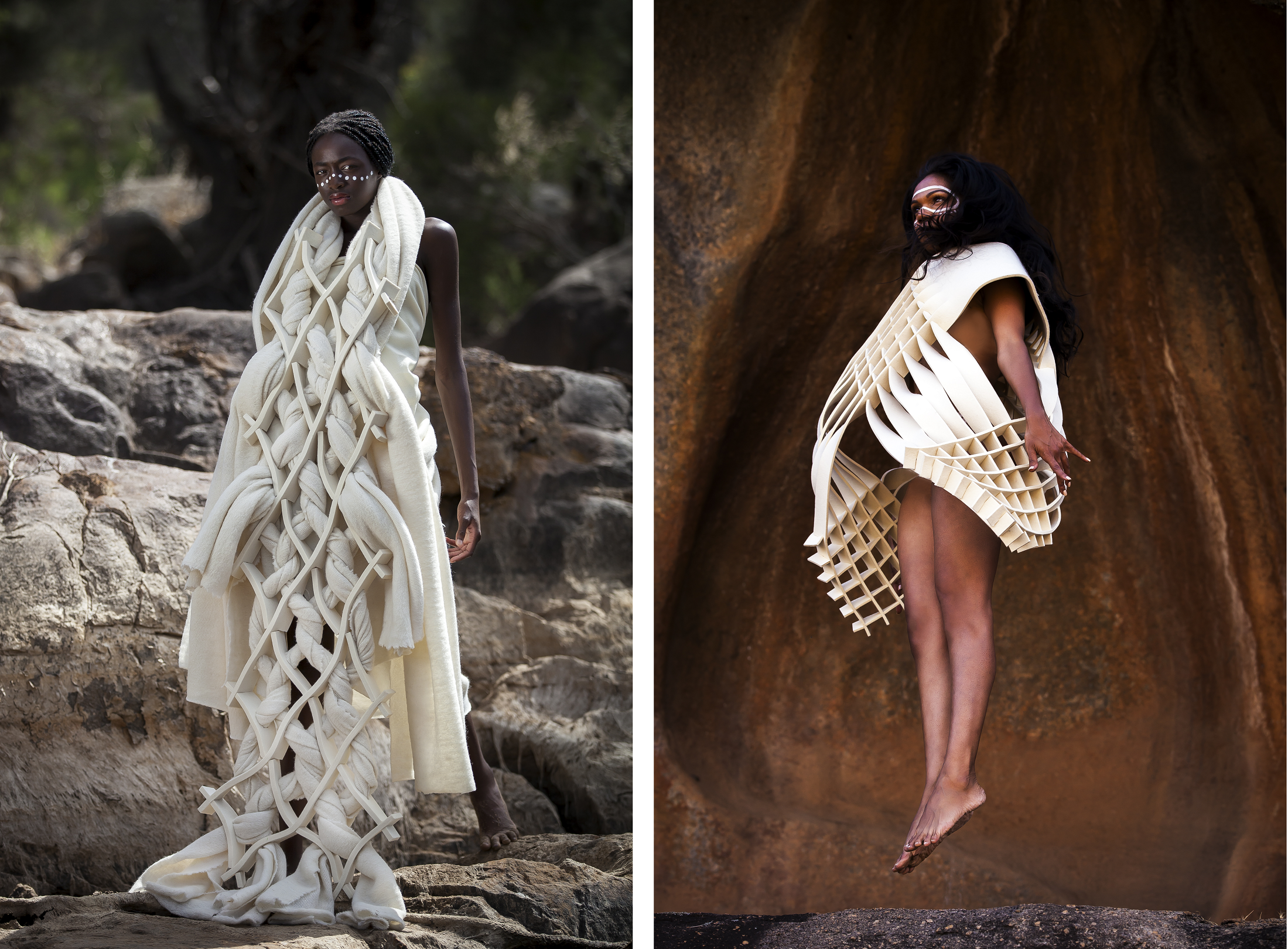
The theme of my new work, to be announced at EFWA2018, is "The Claws of Clothes.” If clothing had claws, how would this change their state of existence? 

This idea was brought about by Professor Shinji Hirai and his team at Muroran Institute of Technology, and their research into "protein resin.” (https://www.omicsonline.org/speaker/shinji-hirai-muroran-institute-of-technology-japan/) In case of  “wool resin,” by compressing wool cloth while applying heat to it, the keratin contained in the wool becomes a resin. 

I thought again about the "human nail,” composed of the same keratin as wool resin. Human nails have great functionality. Our soft fingers are equipped with hard claws. It is said that this was perhaps the main key to the development of mankind. Human beings who acquired delicate fingertips managed to increase their brain capacity by using these hands and so, developed intelligence. When I considered these nails that have played such a big role in our evolution, a new question was born. I wondered if clothes would change, if they were equipped with claws.

4.png

What materials do you work with - organic, reclaimed, etc.? 

This time, I wanted to use wool and “wool resin,” as my main material. 

This is an animal-derived resin, is not a petroleum-derived material and is biodegradable. This material has great potential. To resinify wool, I first prepare a wool cloth from which the surface layer of cuticles has been removed. Next, I stack this cloth and compress it while adding heat, at a temperature of about 150 degrees. By doing so, the cloth becomes resin. Another great feature of this is that you can dye the finished resin. By using a method of laying fabric during the processing, you can create various facial expressions as decorations. Also, instead of sewing clothes traditionally, plasticization by pressing can be used to bond the fabrics, which may lead to a reduction in cost. 

However, it's very expensive to make products from it, and we need financial assistance. If anyone is able to contribute, please get in touch. (tanaka@studio-membrane.com)

What are the biggest challenges you face as a sustainable designer? 

Well, I don't have much experience as a sustainable designer. 

I realize that, without expert advice, it is difficult to understand the concept of 'ecology' removed from the current trends, and to get accurate facts regarding 'ecosystem.’ Gaining familiarity with the background context for scenes that often use words like 'recycling' and 'environmentally friendly' and determining what these words really mean practically speaking, is a big challenge for me right now.  Therefore, I believe that it is essential for designers to collaborate with engineers and environmental ethics professionals for the future of an authentic, fundamental Eco-fashion.

How do you help customers understand the higher cost of sustainable garments when they are so inundated with sweat shop-produced, cheap merchandise? 

Clothes represent the philosophy of the person wearing them. I hope that people who agree with the concept and quality of the work I propose will be satisfied with the price as well. Furthermore, my work places heavy emphasis on the conceptual aspect, and I don't imagine that people will use my clothes as casual wear. Therefore, it is necessary to think of the pieces as a kind of artwork. 

6.png

What can we look forward to seeing on the runway at Eco Fashion Week Australia? 

In my collection entitled ”The Claws of Clothes,” I present the idea of creating clothes on the body without sewing anything together. Instead of sewing traditionally, plasticization by pressing can be used to bond the fabrics, which may lead to a reduction in cost. At the moment, the issue of making the material durable against repeated washing is being addressed.

We began exploring new possibilities concerning clothing made using protein resins. The resinify of protein is advanced technology with practical use in mind, and enhanced accuracy is necessary. At the same time, I would like to share the wonder of this research with many people.

How do you incorporate sustainable living in other areas of your life? 

First, I consider how I should bury my body. Our bodies accumulate waste in the process of taking in food and air. Therefore, in order to return the body to nature cleanly, it is necessary to devise some sort of contrivance. An excellent practice example is a project being undertaken by artist Jae Rhim Lee (http://coeio.com/). She suggests a way of cultivating edible mushrooms to consume your corpse in an environmental way. Moreover, in the area of fashion design, I want to propose something called "clothes to die in". I think it is a very exciting idea. 

1.jpg

Second, I think about how the relationship between my body and my surrounding environment can be connected to the clothes I create and wear. For example, what if what you ate was reflected in your clothes? I mean, if you recorded 365 days of your meal data and reflected it in the textile design of your clothes? If you ate only instant noodles, you would finish up with a ridiculously chemical design. What if we ate more healthily, and as a result, got clothes with beautifully designed graphics? We may be able to design clothing that triggers people to review their own eating habits. 

In my opinion, everything in life can be infused into fashion design.

Links

  • Website - http://www.studio-membrane.com/
Tags: studio membrane, Tanaka Hiroaki, Japan, Eco Fashion Week Australia 2018, Eco Fashion Week Australia, efwa, EFWA 2018, fashion, runway, eco fashion, sustainable fashion, ethical fashion, perth, port douglas, australia
Newer / Older
Back to Top
 

Follow us on Social Media

© 2023 Eco Fashion Week Australia™️, All Rights Reserved.